
Another great post by our guest editor, John Worthington.
When I previewed the Dual-Lens Assessment Model, a colleague challenged me with a sharp observation.
“I’m still having some doubts about the value dimension, as I think it’s often a deliberate choice, a chosen strategy and not a matter of restricted power of execution.”
That’s a great point — and it deserves a careful answer.
Strategy vs. Maturity
Yes, value can be a strategic choice. An organization can decide to compete as:
- Technology-Driven (low-cost provider),
- Service-Driven (focused on functionality),
- Customer-Driven (experience-oriented), or
- Business-Driven (aligned to strategic outcomes).
But choice alone isn’t the same as maturity.
- Choice without capability = fragility. You may aspire to be “customer-driven,” but without governance, culture, and learning routines to support it, the ambition collapses under stress.
- Capability without choice = drift. You may have well-documented, efficient processes, but if no one asks whether they matter to customers, you’re just polishing the wrong wheel.
That’s why the Dual-Lens model separates inside-out capability from outside-in value maturity.
The Five Dimensions of Value Creation
The USM-aligned Value Maturity Model (VMM) doesn’t try to dictate your strategy. Instead, it asks: is your chosen strategy real, lived, and sustained across the system?
It does this through five dimensions:
- Value Orientation – Is there a shared definition of value, grounded in customer outcomes?
- Business–Service Integration – Are services structurally tied to business goals?
- Performance & Learning – Do you measure outcomes and adapt based on feedback?
- Governance & Control – Are roles and accountabilities aligned to value delivery?
- Behavior & Culture – Do people actually act in ways that co-create value?
Each dimension is outside-in. They don’t ask “are we doing things well?” (capability) — they ask “are we doing the right things?” (value).
How This Ties Back to USM
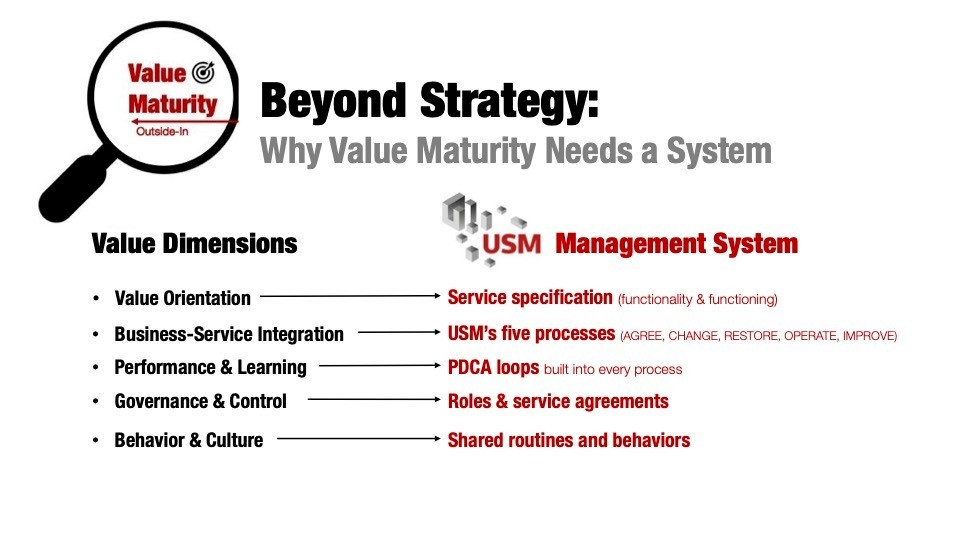
The five dimensions aren’t bolt-ons. They map directly to the USM management system:
- Value Orientation → Service specification (functionality & functioning)
- Business–Service Integration → USM’s five processes (AGREE, CHANGE, RESTORE, OPERATE, IMPROVE)
- Performance & Learning → PDCA loops built into every process
- Governance & Control → Roles & service agreements
- Behavior & Culture → Shared routines and behaviors
USM provides the stable system logic. The value dimensions check whether that system is aligned with what matters outside the walls of the organization.
Seeing the Full Picture
Put together, the two lenses give us a strategic map:
- Low capability + low value → Misaligned & Inefficient
- High capability + low value → Overengineered & Misaligned
- Low capability + high value → Aligned but Inconsistent
- High capability + high value → Aligned & Scalable
This is the essence of the Dual-Lens model: strategy and execution, intent and evidence, outside-in and inside-out.

Final Thought
Value maturity isn’t about picking the right strategy. It’s about ensuring that whatever strategy you pick is embedded, evidenced, and sustained by the way your system actually works.
Or put more simply:
👉 Strategy sets the direction. Maturity tells us whether we can walk the road.
==/==
 If you enjoyed John's post and it made you think about improving your own organization, please check out his USM Professional profile and his personal website, or better: contact John for a free consultation.
John has posted this blog earlier in his USM method News LinkedIN newsletter. If you want to read his posts when they're published - subscribe to John's channel.