
A post by our guest editor, John Worthington.
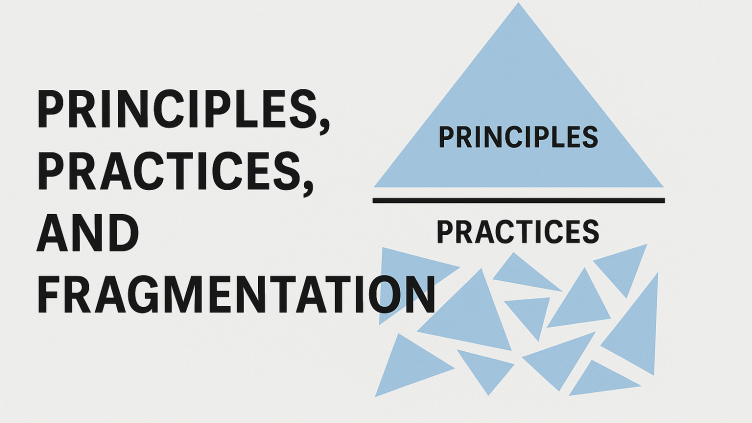
In every USM Foundation class, we spend time distinguishing principles from practices — and for good reason. They’re not just different concepts; they’re different forces. Principles unify. Practices diversify. When they’re confused, enterprises — and even societies — begin to fragment.
Principles: The Architecture of Unity
A principle is a fundamental, generally applicable rule or belief that guides behavior across contexts. It’s universal. It’s timeless. It answers why.
Think of principles as the invisible architecture that holds a system together — few in number, stable in meaning, and independent of circumstance. When shared and understood, principles create alignment across departments, partners, and even cultures. They allow variation in execution without chaos in intent.
That’s why too many principles can be just as dangerous as too few. If every team or framework defines its own “core principles,” the organization no longer has a compass — only a constellation of competing truths.
Practices: The Architecture of Adaptation
A practice is a way of working in a specific context — a local decision about how something gets done. Practices are essential because they turn principles into action. They adapt the universal to the particular.
But when practices are mistaken for principles, they gain authority without universality. Local habits start masquerading as eternal truths. A method designed for one situation is suddenly enforced on all — and what was once flexible becomes dogma.
You’ve seen it happen:
- “Always automate everything.”
- “Follow Agile no matter what.”
- “Customer first,” even when it undermines sustainability or equity.
These aren’t principles — they’re context-dependent practices elevated to moral status. And when every local rule claims universal authority, the organization begins to pull itself apart.
From Fragmentation to Coherence
The result of this confusion is fragmentation — not just procedural, but philosophical.
- Different business units drift in different directions.
- Frameworks overlap and contradict each other.
- People lose sight of the shared why behind their diverse hows.
This isn’t only an enterprise problem; it’s a social one. When nations or corporations redefine “fairness,” “accountability,” or “trust” on their own terms, coherence across systems — even global ones — collapses. Principles, once meant to unify, become boundary markers that divide.
How USM Restores Structural Coherence
The Unified Service Management (USM) method resolves this fragmentation by grounding all service delivery in a small, universal set of principles and five non-redundant processes.
In USM:
- Principles define the why — the logic of good governance.
- Processes define the what — the generic workflows that apply everywhere.
- Practices define the how — local adaptations tuned to context.
Every practice in ITIL, DevOps, or Agile can be traced back to a USM process — meaning we don’t need to multiply principles or invent new “ways of working.” We simply need to understand how they all fit within one coherent architecture.
That’s what makes USM more than a framework. It’s a unifying language — a way to manage all service systems through the same structure, without suppressing local creativity.
A Simple Test
In class, I often say:
“If a principle must always apply, ask: could it hold true for every organization, everywhere, forever? If not — perhaps it’s not a principle. It’s a practice.”
Principles are few because truth is scarce. Practices are many because life is messy. The art of management — and of civilization — is learning to keep those two things in balance.
Closing Thought
In an age where every team, tool, and algorithm wants to define its own “way of working,” coherence is the new competitive advantage. If we can agree on a handful of universal principles, we can allow infinite variation in practice — without losing sight of the whole.
That’s what USM offers: A method not for control, but for coherence. A reminder that simplicity isn’t about less — it’s about alignment.
“Structure drives behavior — and shared principles drive shared purpose.”
#ServiceManagement #USMmethod #Governance #Leadership #DigitalEthics #AIgovernance #ContinuousImprovement
==/==
 If you enjoyed John's post and it made you think about improving your own organization, please check out his USM Professional profile and his personal website, or better: contact John for a free consultation.
John has posted this blog earlier in his USM method News LinkedIN newsletter. If you want to read his posts when they're published - subscribe to John's channel.