
A post by our guest editor, John Worthington.
I enjoyed the weekly OSC Meetup and the topic of the double loop model spawned this post. I’m currently re-reading The Fifth Discipline by Peter Senge—a classic that continues to resonate deeply with those of us working in service management and organizational change.
What struck me most this time around is how well the core disciplines of a learning organization align with the Unified Service Management (USM) method—and how both are strengthened by Double Loop Learning.
NOTE: Thanks to the OSC Open Service Community and Matthew Seaman, Executive Director of the Consortium for Service Innovation for a great presentation on Knowledge-Centered Service (KCS) and Intelligent Swarming.
The Learning Organization Meets the Service Organization
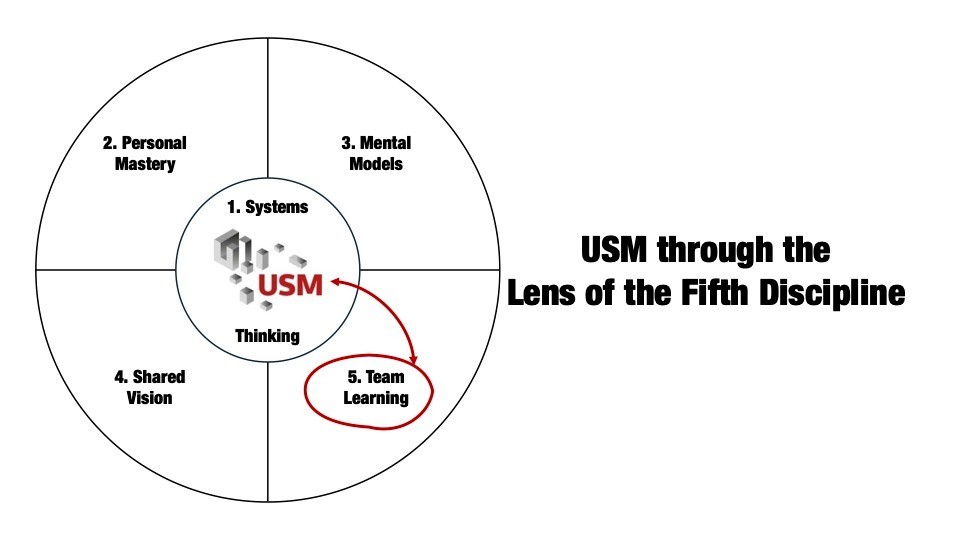
Senge identifies five key disciplines of learning organizations:
- Systems Thinking
- Personal Mastery
- Mental Models
- Shared Vision
- Team Learning
Now, let’s reflect on how these apply to USM:
- Systems Thinking USM is a systems-based approach. It treats every service as part of a larger whole, managed with a universal model of roles, processes, and means. This directly supports Senge’s idea that we must understand how things influence one another within the whole.
- Mental Models USM asks organizations to adopt a new model—a shared, repeatable language for managing services. Double Loop Learning helps us question and refine the assumptions behind these models over time.
- Team Learning & Shared Vision A standardized management system like USM fosters collaboration. Everyone follows the same process model, understands the same roles, and uses the same templates—enabling collective improvement and alignment with shared goals.
- Personal Mastery USM emphasizes clarity of roles and accountability. With a clear model and governance structure, individuals know what’s expected and can grow in their role—an ideal condition for personal mastery.
Why Double Loop Thinking Matters Even More
Senge’s work reminds us that learning organizations thrive not just by solving problems but by rethinking the frameworks and beliefs that shape their actions.
That’s where Double Loop Learning comes in. It enables service teams to do more than fix incidents or improve workflows—it allows them to step back and ask: Are we managing services in the right way? Are our policies and designs aligned with the outcomes we want?
Final Thought
USM gives us a foundation. The Fifth Discipline gives us a philosophy. Together, they encourage us to build service organizations that learn, adapt, and lead—not just react.
If you’re re-reading Senge too—or just starting your journey—consider how USM can provide a practical structure to bring those big ideas to life.
Curious how to make your IT team a true learning organization? Let’s talk. I offer cost-effective coaching based on the USM method, grounded in decades of experience with service management transformation.
==/==
 If you enjoyed John's post and it made you think about improving your own organization, please check out his USM Professional profile and his personal website, or better: contact John for a free consultation.
John has posted this blog earlier in his USM method News LinkedIN newsletter. If you want to read his posts when they're published - subscribe to John's channel.