
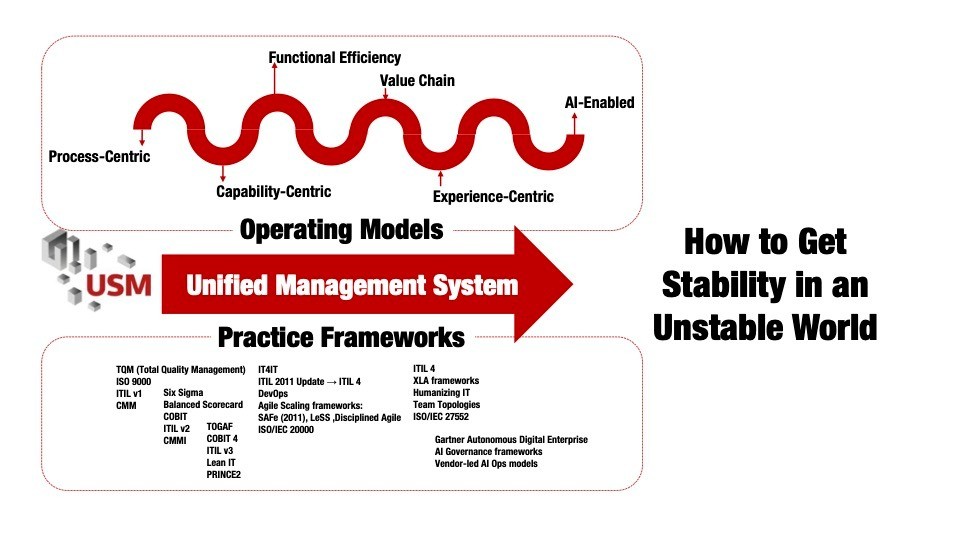
In a VUCA world, operating models come and go, but a management system like USM provides the stability, accountability, and social capital enterprises need to thrive.
We live in what the military first called a VUCA world – volatile, uncertain, complex, and ambiguous. Markets shift overnight, technology evolves at dizzying speed, and artificial intelligence threatens to disrupt not just industries, but how we govern accountability itself.
So how can an organization stay stable in the middle of this chaos?
The answer lies in something many enterprises overlook: a management system.
Cybernetics and USM: Why Stability Starts Here
Cybernetics, the science of feedback and control, teaches us that every viable system must have two things:
- Variety management – the ability to absorb complexity without collapsing under it.
- Feedback loops – the ability to learn and adapt without losing coherence.
The Unified Service Management (USM) method is fully aligned with these principles. Instead of dozens of overlapping processes, USM reduces service management to a non-redundant set of five processes and eight workflows. That’s variety reduction in action – making work manageable without stripping away adaptability.
This alignment with cybernetics means USM doesn’t just “document processes.” It provides the execution engine that keeps services accountable, traceable, and continuously learning.
Outside-In Meets Inside-Out
Most organizations fall into one of two traps:
- Outside-in only: They focus exclusively on the customer experience, but without stable execution their promises crumble.
- Inside-out only: They obsess over processes and compliance, but forget that customers only care about outcomes.
USM marries these two perspectives.
- Outside-in: It starts with the customer’s wish, request, or incident.
- Inside-out: It translates that input into a stable, repeatable workflow.
The result? Every service interaction links customer experience to operational accountability.
Why Humanizing IT (and Work) Matters
People are not just “resources” – they are social beings. Organizations don’t survive on financial capital alone; they depend on social capital: trust, relationships, and shared purpose.
But modern enterprises risk letting AI and automation create accountability sinks – places where responsibility disappears into an algorithm or a committee. USM prevents that by anchoring every action to a clear process, workflow, and accountable role.
That’s how USM supports the Humanizing IT movement: by making technology serve people, not replace their accountability.
Why USM is More Stable than an Operating Model
Here’s the uncomfortable truth: operating models change. They must, because they are tied to market shifts, new technologies, or reorganizations. In a VUCA world, what worked yesterday won’t work tomorrow.
But a management system is different. It’s the underlying architecture that all operating models plug into. It doesn’t matter if you reorganize into product lines, shift from Agile to DevOps, or adopt a new tool—the management system remains stable.
USM provides that stability. It is not “yet another operating model,” but the system of record for how services are managed across IT, HR, Facilities, Finance, or any domain.
The Call to Action: Learn USM
If we are to get everyone in the enterprise rowing the boat in the same direction, we need a cohesive and stable source of social capital. That is exactly what a management system delivers.
Operating models will change. Frameworks will rise and fall. But a management system like USM gives us the stability to adapt without losing our way.
👉 Every business professional – IT and non-IT – should learn more about USM. It is the simplest, most universal way to bring clarity, accountability, and humanity back into the enterprise.
--/--
 If you enjoyed John's post and it made you think about improving your own organization, please check out his USM Professional profile and his personal website, or better: contact John for a free consultation.
John has posted this blog earlier in his USM method News LinkedIN newsletter. If you want to read his posts when they're published - subscribe to John's channel.