
A post by our guest editor, John Worthington.
USM’s Customer-Provider Interaction Model is an ideal link that can help manage experience across complex service supply chains and networks. Here’s why.
Back in the 1980’s we were hell-bent on process. This was the era of goods-dominant thinking. A good example of a link for the enterprise in these days was SIPOC, which could be used for any related stream of activity and at any level of detail.

This focus on a process perspective sharpened the understanding for the operational model of a business capability (Roseman). But there were some drawbacks. The great shortcoming of the input-process-output paradigm is that it leads to a focus on the internal workings of a system so intense that the external world is sometimes ignored or overlooked (Nickols).
By the year 2000, we shifted to service-dominant logic. Services consciously abstract the internal operations of a business capability; instead, the focus is on the overall value proposition.

Processes and services are two complimentary views on the same capability of an organization. Indeed, combining both a process and a service perspective is crucial to effectively addressing experience.
So, we haven’t moved away from processes to services, we’ve combined them for a more comprehensive view of our business capabilities.
Experience management raises this bar even further.
Experience-dominant logic (EDL) emphasizes the importance of creating memorable and valuable experiences for customers. In this context, the "experience-oriented" link would need to encapsulate the journey and interactions that customers have with an organization, ensuring that each touchpoint contributes positively to the overall experience.
Just like there are many established and emerging practices for process and service improvement, there are many practices for improving the customer experience as well. So, both a SIPOC and a service perspective could represent a customer or provider interaction or touch point.
These practices include Customer Journey Mapping, Value Stream Mapping, Moments of Truth, Jobs to be Done Theory, Personalization, Co-Creation, Humanizing IT, 'Social Circuitry', and many more.

A Unified Link for the Enterprise
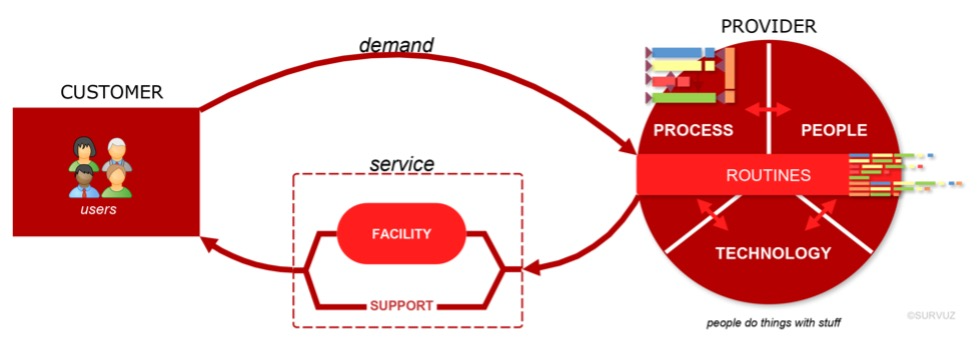
The Customer-Provider Interaction Model in the USM Wiki provides a structured approach for integrating foundational elements of experience, such as processes and services, along with practices to manage and measure experience. (For detailed information, visit the USM Wiki Main Page.)

This model emphasizes standardization and clarity in interactions between customers and providers, ensuring that each touchpoint is optimized for delivering value and enhancing the overall customer experience (USM achieves this without constraining stakeholders either; they are free to use different practice guidance, toolsets, and/or organizational topologies to meet localized requirements).
By integrating processes and services, USM ensures that all aspects of service delivery are aligned with customer needs, enhancing the overall experience. The model encourages regular assessment and improvement of processes and services, using feedback and performance metrics to refine customer interactions.
Simplifying and standardizing your enterprise service management system using the USM method should be a priority for any enterprise looking to achieve levels of value creation maturity that enable effective experience management.
USM provides the concept of a universal link, for the optimal interoperability between the actors in a supply chain or network. This applies between and within any organization (USM Wiki).

The method is supported by the non-profit SURVUZ Foundation and so is very affordable, with 5 processes and 8 standard workflows it is easy to learn, and it can be deployed incrementally and scaled across any enterprise at your own pace.
As service management becomes everyone’s business across the enterprise, make sure your organization has a good handle on the fundamentals with the USM method.
==/==
 If you enjoyed John's post and it made you think about improving your own organization, please check out his USM Professional profile and his personal website, or better: contact John for a free consultation.
John has posted this blog earlier in his USM method News LinkedIN newsletter. If you want to read his posts when they're published - subscribe to John's channel.