
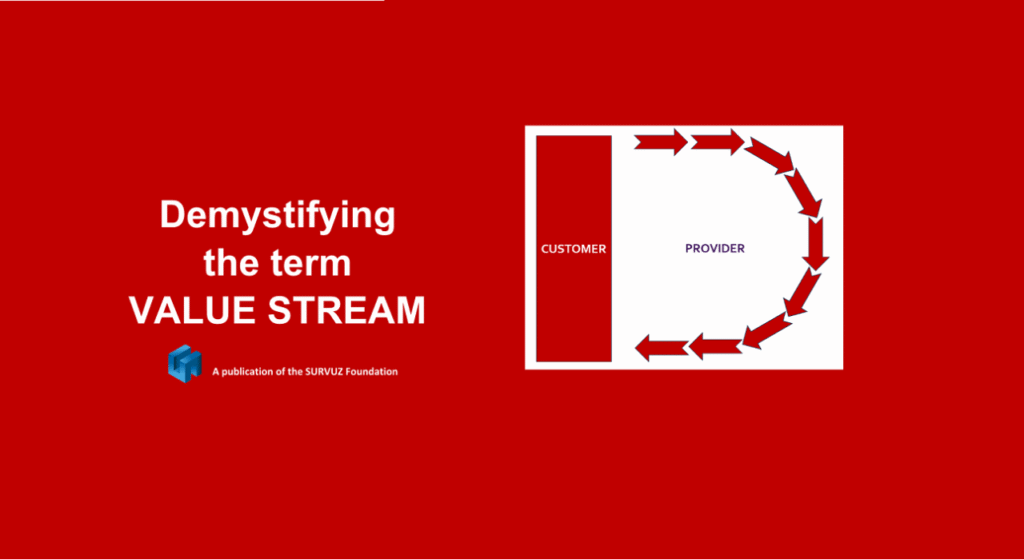
The term ‘value stream’ is subject to a serious hype. As usual with a hype, providers jump the bandwagon when they see opportunities to get turnover in a new market – even if it is an existing market that is just relabeled. Customers are then simply mislead: the providers repackage existing stuff in a new wrapping and sell it as if it’s a new thing that everyone should be using: the Shiny Object Syndrome. That’s how new markets are created without providing added value.
Forbes, Forrester, Gartner, MicroFocus, Techbeacon, they all sell the new toy. DevOpsInstitute, PMI, TOGAF, SAFE, they’re all taking their chances. We’ve got an ISO standard, and we even have a Value Stream Management Consortium and for only $99/year, you can become a member (but of course you can become a corporate partner for $10.000, $20.000 or $50.000/year).
We have:
- Business Architecture Value Streams and ITSM Value Streams…
- Value Stream Mapping… and Value Stream Metrics…
- Value Stream Managers… and Value Stream Owners…
- Value Stream Analytics… and Value Stream Analysis (VSA)
- Value Stream Design… and Value Stream Culture…
- Value Stream Optimization… and Value Stream Improvement…
- Value Stream Integration… and Value Stream Coordination…
- SAFE Value Streams… and Operations Value Streams
- Value Stream Engineers… and Development Value Streams
- We have Value Management Offices, and Value Stream Leaders.
- We have Value Stream Coaches, and we’re so happy to announce that we now have Value Stream Architects!
- We even see companies talking about Enterprise Value Stream Management.
Unfortunately, it’s old wine in new bottles
It's one of the hottest topics around: value streams. But once again – it is old wine in new bottles, and we should treat it as a hoax. It’s a term frequently used by consultants to masquerade that they haven’t been able to solve the previous challenge, but they’ve now found a great new solution: “The Shiny New Thing That Really Helps” – as Paul Wilkinson would call it (SNTTRH). That thing has a great sound to it and can confuse the customer for a long time – maintaining the consultant’s turnover at the desired level. Praise the lord for the new magic!
Everything is a value stream
Value streams are not only turning into the new cash-cow of software vendors and consultants, other sectors also jump the bandwagon. We now see job ads for Value Stream Manager vacancies. Consultants are promoting their value stream guidance offerings. Trainers offer their value stream mapping masterclasses. The main metrics? Lead time, cycle time, deployment frequency, and defects.
OK – it seems obvious by now: The boys have found new toys!
Then what IS a value stream?
ChatGPT does a pretty good job, summarizing the concept of value streams:
A value stream is a term that has been around for a while, but it has remained somewhat of a mystery to many people. The truth is that a value stream is simply a practical workflow that has been used for decades. It is essentially a way of mapping out the journey of a product or service from its inception to its delivery to the customer. At its core, a value stream is just a way of visualizing the processes, resources, and tooling, required to create a good or service and deliver it to the customer. The goal is to identify any areas of inefficiency in the process and make improvements that will lead to greater value for the customer. By clearly outlining the different steps and resources that are required to get a product or service from point A to point B, companies can gain insight into ways to streamline their processes and make them more efficient. The concept of a value stream is nothing new, but it is a valuable tool for businesses of all sizes. By taking the time to map out the journey of their products or services, companies can identify areas of improvement that will help them become more efficient and deliver more value to their customers.”
Of course ChatGPT doesn't have the latest knowledge at its disposal, and it's highly influenced by traditional thinking, but it came close.
So how do we handle 'value streams' then?
If you look through the hype around ‘value streams’, you’ll find a topic that is (still) of serious interest. It relates to a big question:
“How are you going to deliver the things your customers ask for, and how will you manage that as effective and efficient as possible?”
But that question is not new at all. We’ve done that for ages. Delivering end-to-end services to customers, and trying to do that as efficient and effective as possible, with workflow techniques and workflow technology. That doesn’t require a new label. It has always only required a systematic and methodical approach to get the job done the best way you can.
And it’s even getting easier: the latest step in the evolution of service management explains how you need no more than eight workflow templates for the management system of any service provider, covering any value stream you'll ever need.
Lots of questions remaining...
- Where did the value stream concept come from?
- How is a value stream structured?
- What is the process logic behind value streams?
- What are the 8 value stream templates and where do I download them?
- What is the value of Lean, SixSigma, Kaizen, Kanban, and Gemba walks for value streams?
- How does a value stream relate to a customer journey?
- How do I use business process modeling (BPM), swimlanes, and service blueprinting for value streams?
Read the answers to these questions in a free e-book in the Downloads section of the USM Portal.