
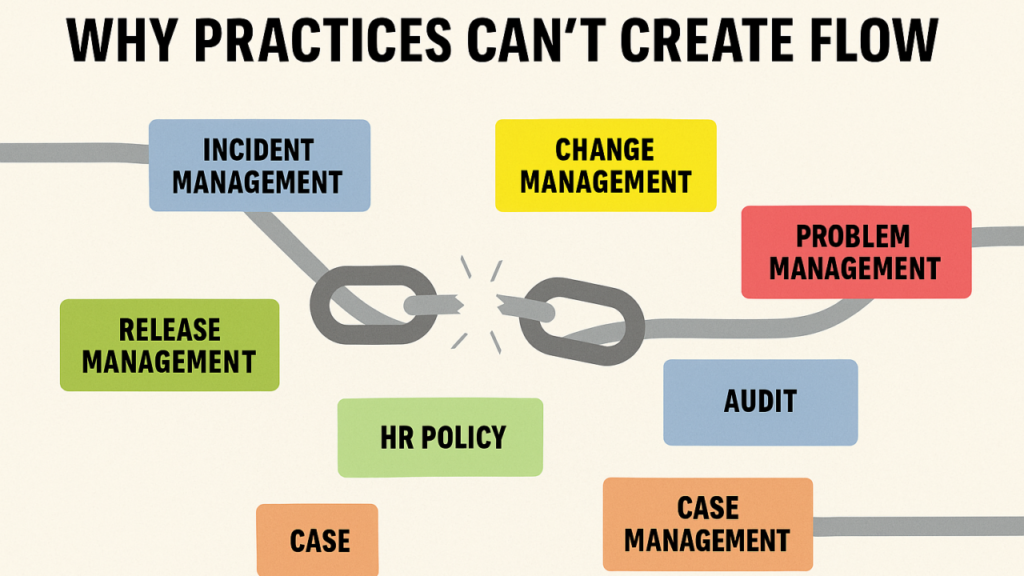
If your enterprise is using multiple practice frameworks, you are guaranteed to have a fragmented critical path.
Not because the frameworks are bad — but because none of them define a universal operating architecture.
Every practice assumes partial ownership of the flow:
- Incident → restore
- Problem → diagnose
- Change → control
- DevOps → automate and deploy
- Agile → iterate
- HR → onboard
- Finance → approve
- Vendors → escalate
Individually? These all make sense.
Together? They collide.
And when they collide:
- flow becomes unpredictable
- handoffs become painful
- governance becomes reactive
- automation becomes brittle
- cross-domain work becomes slow
- ESM dreams fall apart
You can’t integrate what was never architected to work together.
Practices break flow because they mix together two different things: the service (how the work is done), and service management (how all services are governed and improved). When these are not separated, each practice becomes a mini operating system — and the real critical path disappears.