
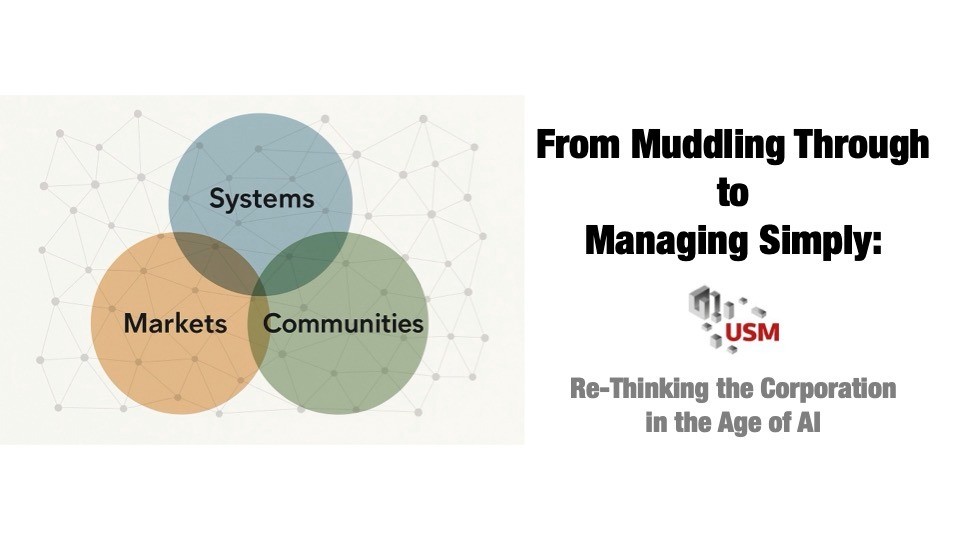
A post by our guest editor, John Worthington.
Every once in a while, something sparks a chain of thoughts you didn’t expect.
For me, it was a recent post by Dean Meyer, reflecting on his mentor, Dr. Charles “Ed” Lindblom — the Yale professor who first articulated the idea of “muddling through” in his 1959 paper, The Science of “Muddling Through.”
In that post, Dean shared a rare audio lecture of Lindblom, and it hit me how relevant those ideas still are — maybe even more relevant — in an era of AI, graph databases, and hyper-connected organizations.
🧩 The Original Idea: “Muddling Through”
In 1959, Lindblom challenged the illusion of perfect planning. He argued that real decision-makers don’t design grand strategies from scratch — they learn by doing, adapting step by step through “successive limited comparisons.”
He later clarified, in Still Muddling, Not Yet Through (1979), that this isn’t aimless wandering. It’s intelligent adaptation in the face of complexity.
That idea shaped generations of systems thinkers — from Herbert Simon’s bounded rationality to Peter Senge’s learning organizations. And as Dean Meyer recognized, it also laid the philosophical groundwork for his Business-within-a-Business model — most fully described in his book Internal Market Economics: Practical Resource-Governance Processes Based on Real Markets (NDMA Publishing, 2019).
Dean has spent a lifetime showing how market principles can bring agility and accountability inside organizations — an extraordinary body of work that deserves attention far beyond the CIO community.
🤖 What Changes in the Age of AI
Today, Lindblom’s constraints — limited information and limited cognitive capacity — are being stretched by AI, knowledge graphs, and predictive analytics.
We now have machines that can process data at a scale Lindblom couldn’t imagine. Yet the paradox is this: even with all that power, human coordination is still the bottleneck.
AI can surface patterns, but it can’t build trust. Graph databases can map dependencies, but they can’t create shared purpose.
We’re still “muddling through” — just faster, and with higher stakes.
That’s why social capital — the trust, reciprocity, and shared norms that make cooperation possible — is now the most critical form of organizational wealth. Without it, automation amplifies chaos. With it, technology becomes an amplifier of human value.
This idea came up recently in an Open Service Community (OSC) meetup where we talked about “the long shadow of behavior.” We realized that behind every system failure — and every success — is a pattern of behavior, trust, and collaboration that either compounds or corrodes over time. (see the meetup replay here)
🧠 From Muddling to Managing
So how do we intentionally harness the learning power of “muddling through” without losing cohesion?
That’s where the Unified Service Management (USM) method comes in.
USM, developed and governed as a non-profit initiative by the SURVUZ Foundation, provides a simple management system — five processes, eight workflows — that define how every organization can coordinate work, learn, and improve.
It’s framework-neutral, tool-agnostic, and universal — the same logic applies whether you’re managing IT services, HR, Facilities, or AI governance.
Far from competing with other models, USM complements them:
- Consultants and framework experts can use it as a structural backbone for ITIL, COBIT, or even Dean Meyer’s internal-market model.
- Executives can use it to align diverse teams under one management system.
- And individuals — even those new to service management — can use it to understand how their daily work connects to value.
USM makes “muddling through” manageable.
💡 Why the Corporation Must Be Rethought
The 20th-century corporation was built for control and predictability. The 21st demands adaptation and cohesion.
AI and data abundance don’t eliminate the need for incremental learning — they magnify it. Every automated decision now ripples across interconnected systems at digital speed. Without shared structure and social capital, even smart organizations become fragile.
So maybe the next evolution of the corporation is neither hierarchy nor market, but a community of capital — economic and social — coordinated by a simple, universal management system.
That’s what I see in USM: A way to make complexity manageable, to keep humanity at the center of automation, and to give every organization — from small nonprofits to global enterprises — a common language for learning.
“In Lindblom’s day, incrementalism was a necessity. In ours, it can be a strategy — guided by structure, sustained by trust, and illuminated by data.”
🧭 Acknowledgments and References
- Charles E. Lindblom, The Science of “Muddling Through” (1959) and Still Muddling, Not Yet Through (1979), Public Administration Review.
- Dean Meyer, Internal Market Economics: Practical Resource-Governance Processes Based on Real Markets (NDMA Publishing, 2019).
- SURVUZ Foundation, Unified Service Management (USM) Method — usm-portal.com.
- Open Service Community (OSC) – ongoing meetups on the future of service management and behavior in systems.
- Assisted in research and synthesis by ChatGPT (GPT-5).
👉 If you’re in the U.S. and want to explore how USM helps simplify service management to improve data quality and extend service management beyond IT, let’s connect. Also, keep in mind the SURVUZ Foundation schedules FREE USM Workshops where you can get an introduction to the method and ask questions.