
A post by our guest editor, John Worthington.
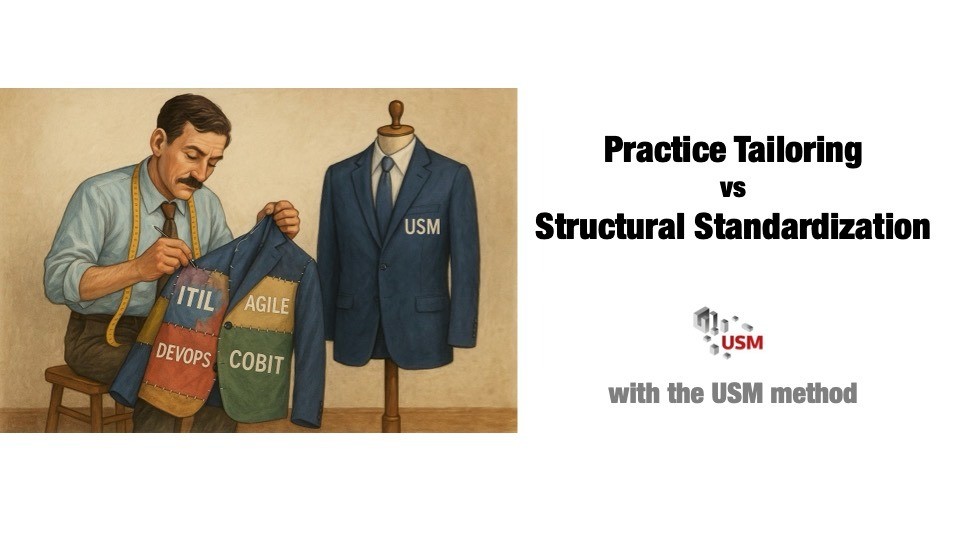
In today's USM Introduction Workshop we got a familiar question; 'why isn't tailoring ITIL-based processes (practices) the same as what USM is doing?'
Practice-based tailoring (like ITIL-inspired customization in ServiceNow) looks smart at first, but over time it leads to workflow sprawl, inconsistent data, unreliable reports, and costly refactors. USM replaces this with structural standardization: 5 non-redundant processes, 8 generic workflows, and a logically repeatable service specification. Instead of reinventing each module, USM provides a stable backbone that keeps data clean and tools sustainable.
The Trap of Practice-Based Tailoring
Most organizations “tailor” practices locally: each team, module, or department adapts incident, request, change, or problem workflows in its own way. The consequences are predictable:
- Workflow sprawl – dozens of variants of the same basic flow across IT, HR, Facilities.
- Inconsistent definitions – “priority,” “state,” and “category” don’t mean the same thing across modules.
- Data fragmentation – the same service shows up under different names and Service Agreements (SA).
- Unreliable reporting – dashboards and AI models reflect inconsistency instead of insight.
- Upgrade pain – customizations pile up until a “refactor” is the only way out.
Why USM Is Different
USM is not another library of practices — it’s a management system with a non-redundant architecture:
- 5 generic processes: AGREE, CHANGE, RESTORE, OPERATE, IMPROVE.
- 8 workflow templates: Every issue type maps to one of these structural patterns.
- Service specification as the anchor: Each service is defined as Facility + Support, each with Functionality (utility) and Functioning (warranty).
This means local tailoring happens at the service specification, not in every tool module. The structure stays stable; practices and tools can change around it without creating chaos.
What the Standards Require
The EN Requirements for USM-Compliant Tooling (SURVUZ, 2020), made available to USM Professionals, make this concrete:
- States: Each issue type (Wish, Change, Incident, Service Request, Risk) has its own defined state sequence, modeled consistently via workflow templates
- Categorization: Minimal categorization is allowed, but every issue must be anchored to its service specification and CI
- SAs: Handling instructions (response, resolution times) must always derive from the linked service and CI
- Risk vs. Problem: Risk is the improvement issue type. Problems are handled as risks
- Catalog & CMDB: The catalog lists facilities and standardized issues; agreements and CI relationships anchor everything
Practical Use Cases
- States Made Comparable
- Categories Reined In
- SAs Made Consistent
- Risk Replaces “Problem”
- Catalog/CMDB Simplified
Why Refactors Disappear
Organizations refactor ITSM tools like ServiceNow every 3–5 years because practice tailoring creates drift. Each refactor can cost millions and delivers only temporary relief.
With USM, drift doesn’t occur: the workflow templates, service links, and issue types are fixed patterns. The tool becomes the execution layer of a single system, not a patchwork of practices.
Building on My Earlier Series
This article builds on my earlier series on Process Alignment vs. Practice Integration, where I explored the difference between trying to stitch practices together and aligning to a universal system.
In those posts, I argued that practice integration creates complexity, while process alignment delivers simplicity. Here, I’ve shown how that principle plays out in tools: practice-based tailoring creates drift and refactors; structural standardization with USM keeps data clean and sustainable.
Final Thought
Practice-based tailoring is why your ITSM tool (like your ServiceNow instance) eventually collapses under its own complexity. Structural standardization with USM is how you stop the cycle — fewer patterns, cleaner data, no refactors.
👉 If you’re in the U.S. and want to explore how USM helps simplify service management to improve data quality and extend service management beyond IT, let’s connect. Also, keep in mind the SURVUZ Foundation schedules FREE USM Workshops where you can get an introduction to the method and ask questions.