

Demystifying the term ‘Maturity’ – [level 5] Business-driven
At level 5, business-driven, the provider adds value to the customer’s business through a business partnership. They actually become part of the customer’s business. The provider invests at its own riskin the development of services that create (even)

Demystifying the term ‘Maturity’ – [level 4] Customer-driven
At level 4 of the Value Maturity Model, customer-driven, a balance is created between the position of the customer and the provider. The customer and the provider learn to determine together how the service is provided and how value is created for the

Demystifying the term ‘Maturity’ – [level 3] Service-driven
At level 3, service-driven, the role of the customer changes. The customer indicates which services are needed, expressed as the continuous availability of specific systems. They also specify how these systems should be supported to deliver the require

Demystifying the term ‘Maturity’ – [level 2] System-driven
At level 2, system-driven, the technology is under control. It’s either the result of internal production, or – when outsourced – it is delivered by specialized companies that act at level 1 of the Value Maturity Model. The provider can make coherent s

Demystifying the ‘MATURITY’ – Level 1: Technology-driven
The first level in the USM Value Maturity Model is Technology-driven. At level 1, the provider’s attention is focused on delivering goods or actions. Their marketing demonstrates their focus: “we have the best product – it’s better that the product of
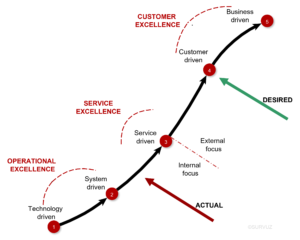
Demystifying the term ‘Maturity’ – The model
There are numerous models that organizations can use to estimate their ‘maturity’. These models often use a scale with 5 or 6 levels. All these models catch some expression of ‘how good’ an organization is at something. The traditional dimension of the
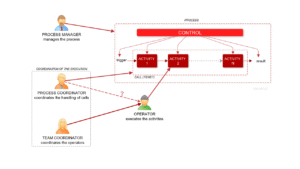
Demystifying the term PROCESS: process control
In this final post on the topic of “Demystifying the term process”, I’ll explain requirement 10 of the 10 requirements that something must meet, before we can use the term ‘process’ in a mature service management context, according to the Unified Servi
Demystifying the term PROCESS: non-redundancy
In this 8th post on the topic of “Demystifying the term process”, I’ll explain requirement 9 of the 10 requirements that something must meet, before we can use the term ‘process’ in a mature service management context, according to the Unified Service
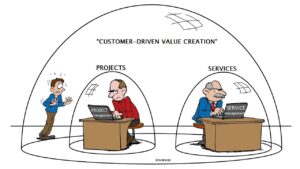
Demystifying the term PROCESS: Projects follow processes
In this 7th post on the topic of “Demystifying the term process”, I’ll explain requirement 8 of the 10 requirements that something must meet, before we can use the term ‘process’ in a mature service management context, according to the Unified Service