
Nine out of ten organizations that claim to operate in a matrix structure do not actually do so.
They operate in a hierarchy with a second hierarchy laid across it. Teams and functions. Regions and products. Business units and customer segments. These are all different ways of organizing the same dimension: the dimension of people. That does not create a matrix. It creates dual reporting lines, which compete for the same people.
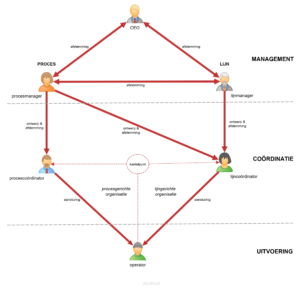
A true matrix operates along two fundamentally different dimensions: people and processes. Who does the work versus how the work flows. Managing people versus managing the work. Only when both dimensions are active simultaneously, and only when it has been determined in advance which dimension takes precedence in the event of a conflict, does a matrix emerge that deserves the name.
And precisely then does the matrix prove to be what it is actually supposed to be: more effective, more efficient, and more pleasant to work in than the rake from which it emerged.
That this rarely succeeds has little to do with incompetence, and everything to do with power. Anyone who seriously implements process management takes influence away from middle managers and gives it to process coordinators. That undermines the existing pecking order, and that resistance is stubborn and rarely explicitly voiced. The transition to a process-based organization - with a true matrix - takes this into account and brings out the best in the available managers and coordinators - both line managers and coordinators as well as process managers and coordinators.
What does your matrix actually look like?
Download the paper
In the new SURVUZ paper “When Your Matrix Organization Isn't Actually a Matrix,” we explore this topic in depth, including three diagnostic questions for your own organization.
Download it for free via the link below, or simply click the cover at the top of the page. No registration required.
